
Docker has become an almost standard tool in modern web development. It allows developers to isolate environments, run the same configuration on different machines, and reproduce complex infrastructure locally.
But does every Laravel project really need Docker? In practice, no.
What Is Laravel Herd?
Laravel Herd is a native environment for local PHP and Laravel development on Windows and macOS.
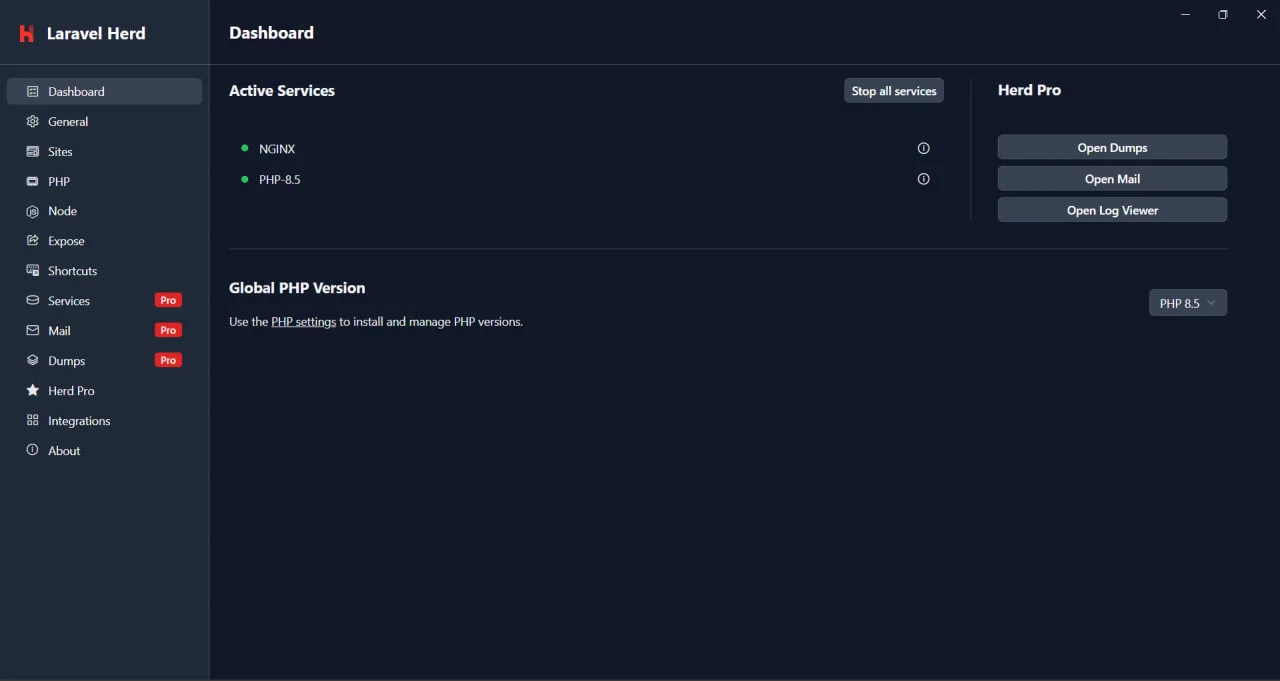
Interestingly, Laravel Herd is recommended throughout the official Laravel ecosystem, yet for some reason it still seems less popular among developers than I would expect.

After installing Herd, a developer gets a ready-to-use environment with PHP, nginx, Node.js, and Laravel tools. A new project can be created with just a few commands:
laravel new my-project
cd my-project
herd open
Herd automatically works with local domains and supports HTTPS, for example:
https://my-project.test
No separate nginx configuration, hosts file setup, or Docker containers are required. For fast local Laravel development, this is often more than enough.
Laravel Herd vs Docker
The main difference is the approach. Docker runs the development environment inside containers, while Herd runs PHP, nginx, and other required components natively on the operating system.
For a small or medium-sized Laravel project, the second approach is often more convenient. For me, another major advantage of Herd is the speed of the daily development workflow and the ability to access several projects immediately by running just one application.
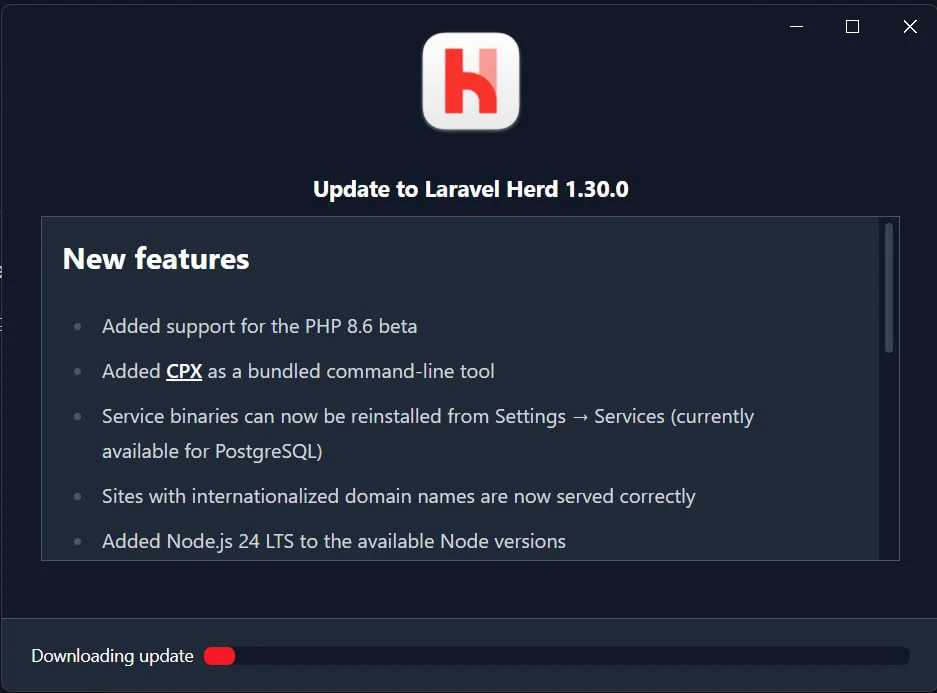
Thanks to Herd and one of its updates, I found out that a new PHP 8.6 version was coming 🙂
Why Can Herd Be Better for Simple Laravel Projects?
- Lower overhead — there is no need to keep a separate containerized environment running all the time.
- Faster local development workflow — projects are available almost immediately.
- Simpler setup — less time is spent configuring the local environment.
- Multiple PHP versions — convenient when working with several Laravel projects at the same time.
For a Laravel project that mainly needs PHP, nginx, and a database, running a complete Docker environment is not always justified. This becomes especially noticeable when an IDE, browser, database tools, AI development tools, and several projects are open at the same time.
An Interesting Feature — herd.yml
One of Docker's traditional advantages is the ability to store environment configuration together with the project. Herd partially solves this problem as well. The command:
herd init
can create a herd.yml file in the project root. It can describe project-specific configuration, such as the PHP version and local site settings. This means you can get some of the benefits of a reproducible local environment without maintaining a complete Docker infrastructure.
When Do You Still Need Docker?
An important point: Docker is not going anywhere. For complex projects, it remains an extremely useful tool.
I would choose Docker when:
- the project has a complex microservice architecture;
- the local environment needs to reproduce production as closely as possible;
- the whole team must work in an identical environment;
- the project has specific system dependencies;
- many interconnected services are involved;
- containers are already part of the CI/CD or production infrastructure.
Laravel even has its own official tool, Laravel Sail, which provides a convenient interface for Docker-based local development.
So the real question is not which tool is better in general. A better question is: does Docker solve an actual problem in this particular project?
Quick Answer
Do you need Docker for Laravel?
No. Laravel works perfectly well without Docker. For local development, you can use Laravel Herd, which runs PHP and nginx natively on Windows or macOS.
Which is faster for local Laravel development — Herd or Docker?
Herd runs natively without a container layer, so startup is very fast and the overhead is minimal. The actual difference depends on the operating system, filesystem, and Docker configuration.
When is Docker the better choice?
When you need isolation, a reproducible environment, a complex set of services, or close parity between the local environment and production.
Is Laravel Herd suitable for professional development?
Yes. Herd is built specifically for PHP and Laravel development and supports multiple PHP versions, local domains, HTTPS, and other tools required for a professional local development workflow.
Comments (1)
Данило
•Дуже цікава стаття 👍 Сам нещодавно перейшов на Laravel Herd і справді відчув, наскільки простіше працювати без Docker. Думаю, Docker потрібен далеко не завжди. Для звичайних Laravel-проєктів Herd — дуже зручний варіант.